Fredericksburg, TX · Gillespie County · The Texas Hill Country
If you've been finding scorpions on the floor at night, wasps under the eaves, or crickets and flies getting into the house, we'd be glad to come out and take a look. We've provided scorpion control and insect treatment in Fredericksburg and Gillespie County since 1979, so we know the striped bark scorpion and the other pests that are common in Hill Country homes. Scorpions, spiders and household insects are covered on our scheduled residential plans, and if they come back between visits, we come back out at no additional charge.
If you've found a scorpion in the house, it most likely came in from outside. For most of the year they live under rocks, paving stones and landscaping material. When the weather turns hot and dry, they come indoors looking for water and somewhere cooler. A store-bought spray only takes care of the one you saw, and the same is true of spiders, roaches, crickets, silverfish and the other pests we treat.
Hill Country Pest Control has been family owned and operated in Fredericksburg since 1979, and we've treated scorpions, spiders and household insects in Gillespie County homes and businesses many times before. We'll come out, find where they're getting in, and treat the house inside and out. On a scheduled plan, if a covered pest comes back between visits, we come back out and treat it at no additional charge.
Scorpions, spiders, roaches, crickets, flies and silverfish are covered on every residential pest control plan and commercial pest control program, and we also treat wasps, bees and mosquitoes. Ants, termites, rodents and fleas each have their own page: ant control, termite control, rodent control and flea control.

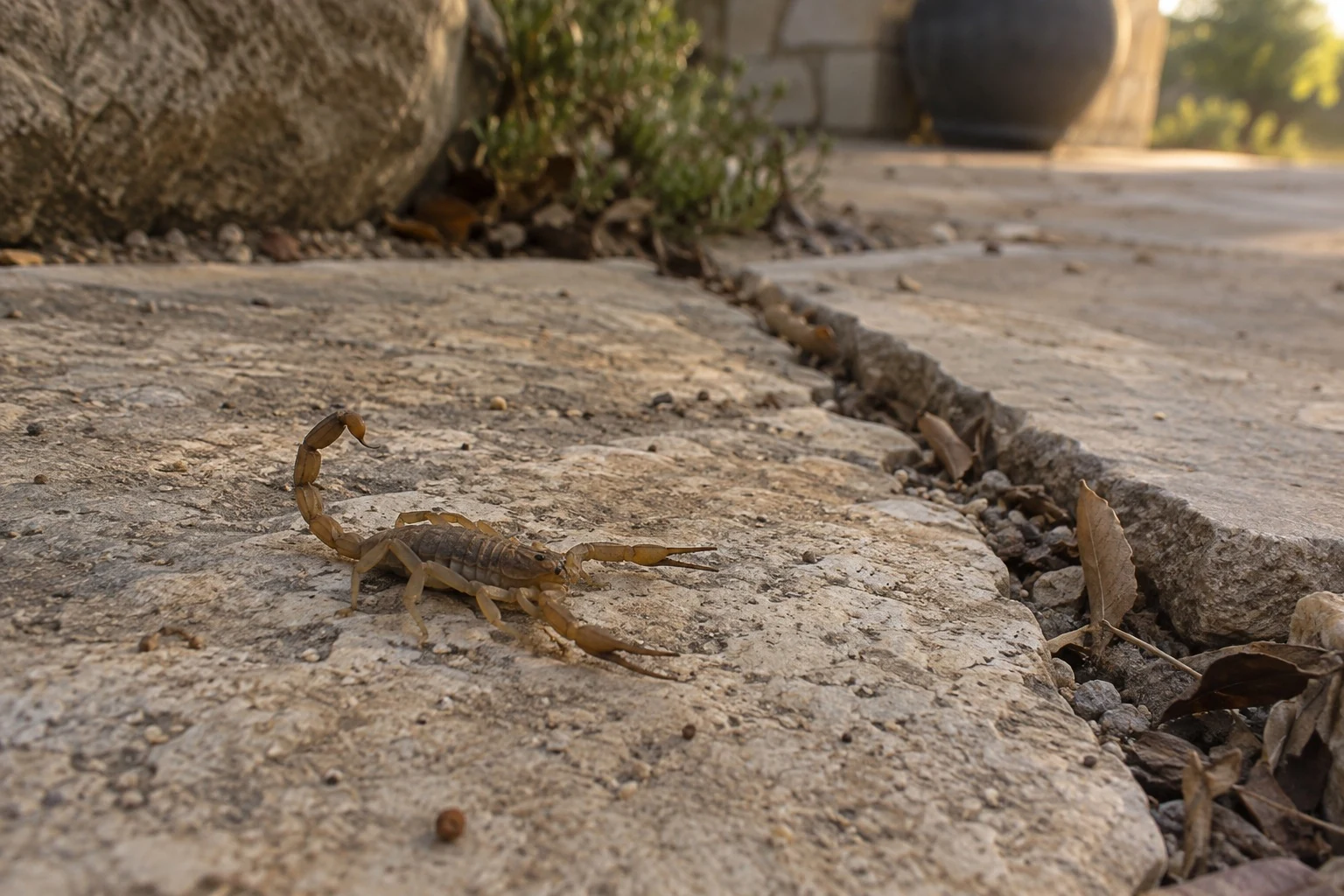
The scorpion that gets into Hill Country homes is the striped bark scorpion, yellowish tan with two dark stripes down its back. The Texas A&M AgriLife Extension Service's Field Guide to Common Texas Insects notes that “It is common for them to climb, and many reports in homes are associated with attics.” Our scorpion control treats the house inside and out, and we'll show you where to prune back and fill gaps so fewer of them get in.
Photo: Robert Webster, CC BY-SA 4.0

Most of the spiders around a Fredericksburg home are harmless. The two that aren't are the brown recluse and the black widow, and both are described below. Our spider control treats the house inside and out, along with the garage and outbuildings, and we'll recommend cutting shrubs back and sealing gaps so they have fewer places to hide.
Photo: Shenrich91, CC BY-SA 3.0

Roaches come in through pipes, drains and the cracks and gaps on the outside of the house. Because they're nocturnal, a nest can go unnoticed until overcrowding forces them into the open. They are also easy to overlook because of their size. The Texas A&M AgriLife Extension Service's Field Guide to Common Texas Insects notes that “The adult German cockroach is about 5/8 inch long.” Our German cockroach pest control finds where they're living and treats it directly.
Photo: Clemson University, USDA Cooperative Extension Slide Series, Bugwood.org, CC BY 3.0 US

Mosquitoes spread disease. The Texas A&M AgriLife Extension Service's Field Guide to Common Texas Insects notes that “There are about 55 species of mosquitoes in Texas (170 species nationally).” Draining standing water, wearing light-colored clothing and using repellent all help. When that isn't enough, our mosquito control treatment brings the population down around the house and the yard.

If you have wasps, yellow jackets, hornets or carpenter bees on the property, we recommend leaving the nest alone until we arrive. Stings cause severe pain, and as the Texas A&M AgriLife Extension Service's Field Guide to Common Texas Insects notes, “when nests are disturbed, defending worker wasps can inflict multiple stings”. Yellow jacket pest control starts with locating the nest, because as the guide says, “Nests are most often underground, but occasionally are found in wall voids and indoors.” Our wasp control, hornet removal and carpenter bee pest control all work the same way. We inspect, treat the pest and remove the source.
Photo: Robert Webster, CC BY-SA 4.0

Crickets are loud, and they're hard to control because a female lays hundreds of eggs. The Texas A&M AgriLife Extension Service's Field Guide to Common Texas Insects notes that they “Prefer outdoors, but will be attracted to lights in large numbers and invade homes.” Once inside, they feed on paper, wood and fabric. Our cricket control treats the house and the ground around it, and we'll recommend sealing openings and clearing debris so fewer of them get in.

Flies spread bacteria from animal waste and decaying material, and some of them bite. The Texas A&M AgriLife Extension Service's Field Guide to Common Texas Insects explains where they come from: “Female flies lay numbers of eggs in suitable larval food sources such as decomposing food in garbage, animal excrement or other decomposing organic materials.” Keeping up with waste removal and sealing entry points goes a long way. When flies are still a problem, we can apply a residual treatment outside the house.

Silverfish hide well, so the damage is often noticed before the insect is. They live in damp, humid areas and feed on sugars and starches, which is why they chew holes in books, clothing and upholstery. The Texas A&M AgriLife Extension Service's Field Guide to Common Texas Insects describes them as “fast running and mostly active at night”. Our silverfish control starts with removing what they feed on and bringing the humidity down. Then we treat where they're living.
Photo: Siga, CC BY-SA 3.0
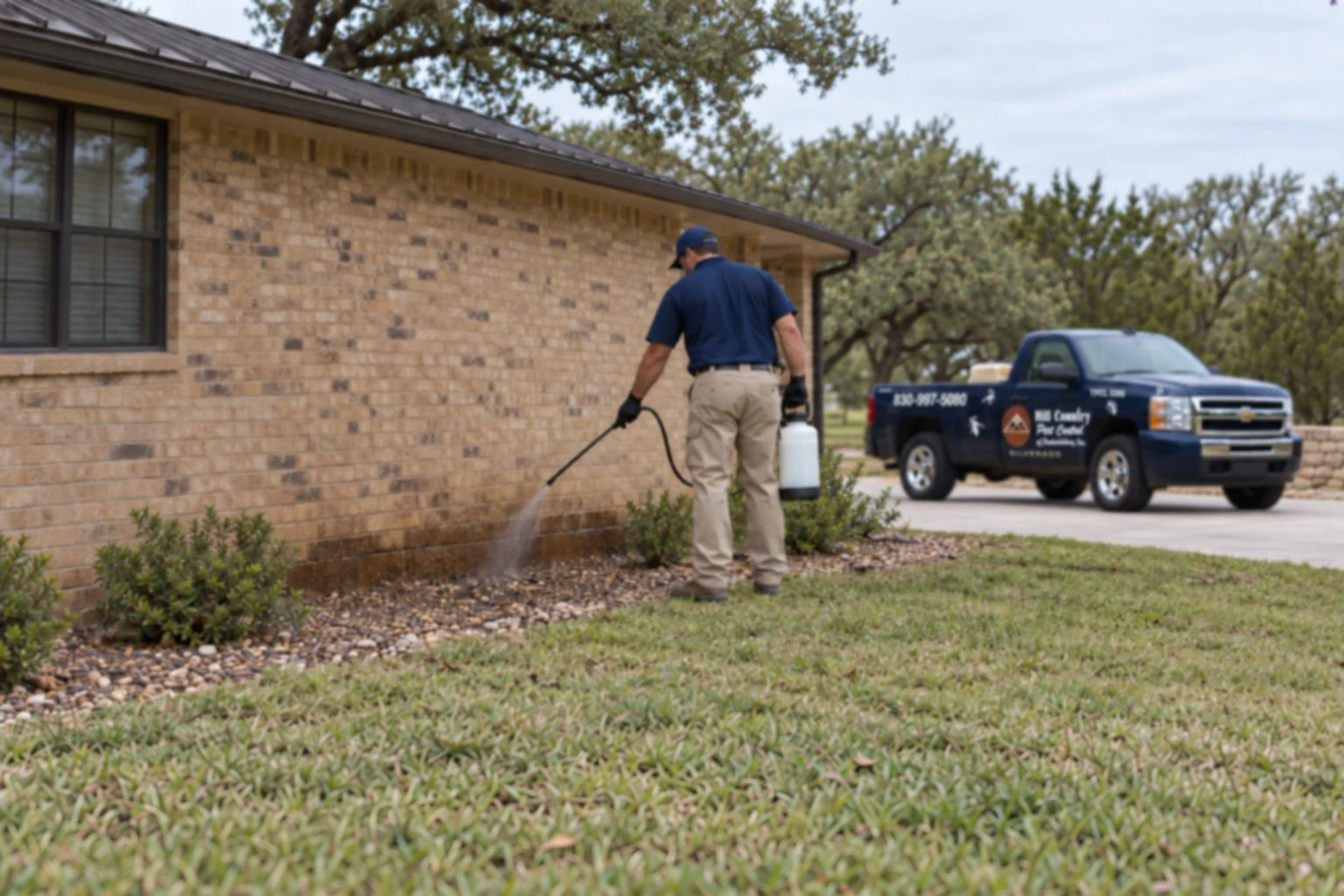
Scorpions, spiders, roaches, crickets, flies and silverfish are covered on every one of our residential pest control plans, and we treat wasps, bees and mosquitoes as well.
We stand behind our work. If a covered pest comes back between your scheduled visits, we come back out and treat it at no additional charge. Please note that the guarantee applies to scheduled plans only, not to a one-time visit.
We've treated Fredericksburg-area homes for scorpions, spiders and household insects since 1979, and in most cases the technician who comes out has seen your problem many times before.
Most spiders in a Hill Country home are harmless, and only two are worth worrying about. The first is the brown recluse. The Texas A&M AgriLife Extension Service's Field Guide to Common Texas Insects says “The color is generally yellowish brown but it can vary.” The violin marking identifies it: “The base of the violin mark is at the front of the carapace and the 'neck' of the violin extends backward toward the abdomen.” Its bite causes blisters and swelling and can bring on fever and infection.
The second is the black widow, which the Field Guide to Common Texas Insects describes as “typically shiny black with red markings”. Its webs are found “in barns, rural privies, and other outbuildings” and “are usually placed low to the ground”. Its venom “is highly virulent” and affects the nervous system, though the spider itself “is quite timid”. If you're bitten by either spider, please seek medical attention. If you'd like the house and the outbuildings treated, give us a call and we'd be glad to come out.

Insect and scorpion control in Fredericksburg follows a simple three-step process, from your first call to scheduled service.

Tell us what you've been seeing and where, and we'll set up a one-time visit or get you started on a plan.

The technician inspects inside and out, finds where the pests are getting in, and treats the house. The technician will also tell you what was found and what's being used.

On a plan, we come back on the frequency you've chosen and treat the outside of the house each visit. If a covered pest turns up between visits, call us and we'll come back out at no additional charge.
“We had a serious scorpion issue at our House we bought in Mason. Hill Country Pest Control kept coming out until the issue was completely under control! Highly recommend the team at Hill Country Pest Control.”
“We won't use another pest company! Love this crew! Quality service, fair pricing, very respectful and knowledgeable staff.”
“Best service ever!!”
Our scorpion, spider and insect treatments cover homes and businesses across Fredericksburg and Gillespie County. Our service area includes the following towns.
If you don't see your town, give us a call at (830) 997-5080 and we'll tell you if your property is within our service area.

If you have any additional questions, don't hesitate to call us at (830) 997-5080.
Yes. Scorpions are covered on every residential plan. The Texas A&M AgriLife Extension Service's Field Guide to Common Texas Insects notes that “There are no scorpions in Texas that are considered lethal to man.” A sting causes a moderate reaction in most people, though anyone stung should be watched for several hours.
The seasonal pests in Gillespie County follow the weather. Scorpions come indoors when it's hot and dry, ants and termites are most active in the warmer months, and rodents move inside as it cools off in the fall. A scheduled plan covers scorpions, ants and the other household insects through the year. Termite control and rodent control are separate services, and we'd be glad to set those up for you as well.
Most of them aren't. The two to watch for are the brown recluse, yellowish brown with a violin-shaped marking on its back, and the black widow, shiny black with red markings. If you aren't sure, take a photo rather than picking it up, and we'll be happy to tell you what it is.
A treatment of the house inside and out, along with the garage and outbuildings, takes care of the spiders that are there. On a scheduled plan, the exterior treatment on each visit helps keep new ones from settling in.
Because they're nocturnal. Roaches come out after the lights go off and spend the day hidden in cracks and gaps, which is why a nest can go unnoticed until overcrowding forces them into the open. If you're seeing them in daylight, it's worth having the house treated.
Roaches are after food, warmth and moisture, so sealed food containers and less clutter help. It's also worth sealing the cracks and gaps on the outside of the house that let them in. Beyond that, the house needs to be treated. Our cockroach control finds where they're living and treats it directly. The Texas A&M AgriLife Extension Service's Field Guide to Common Texas Insects notes of the German cockroach that “There may be four generations per year.” For that reason, we recommend having the house treated as soon as you start seeing them.
Without seeing them it's hard to say for certain. Sugar ants are one possibility, since they nest near water and forage in kitchens and bathrooms. They're covered on our ant control page. Small roaches are another possibility, and they tend to be seen at night near food and moisture. If you can send us a photo, we'll be happy to tell you which it is.
Fruit flies are drawn to decaying material, so the first step is to find what they're feeding on. Keep up with waste removal and clear out any fruit that has gone soft, and the numbers will drop off once the source is gone. If flies keep coming in from outside, we can apply a residual treatment outside the house.
Standing water attracts them more than anything else, so draining whatever holds water around the property makes a real difference. Yes, we can treat the yard as well. Our mosquito control treatment brings the population down around the house and the yard, and we'd be glad to come out and take a look.
Yes. We inspect, treat the pest and remove the source, whether it's a wasp nest under the eaves or a yellow jacket nest in the ground. Until we get there, please leave the nest alone, because stings cause severe pain and disturbing a nest brings the workers out.
Please keep your distance, because stings cause severe pain. We can't say how long a particular hive will stay, and we don't recommend waiting for it to leave on its own. If bees have settled in a wall, under an eave or in an outbuilding, give us a call and we'll inspect it, treat the pest and remove the source.
They can be. Silverfish live indoors in damp, humid places, and the Texas A&M AgriLife Extension Service's Field Guide to Common Texas Insects notes that they “require a high humidity (75% to 90%) to survive”, so the humidity in the house matters more than the season outside. Our silverfish control starts with the food source and the humidity, then treats where they're living.
Hill Country Pest Control holds Texas structural pest control license TPCL 5395, issued by the Texas Department of Agriculture. Every product we use is applied at the rate and in the places its label allows. If there are pets, children, livestock or anyone with a sensitivity in the household, please let us know before the visit. The technician will explain what's being used and whether anyone needs to stay out of a room during the treatment.
Usually because they are being flushed out of hiding rather than moving in. A treatment can bring insects out of wall voids and other hiding places before it finishes working on them, so activity can appear to increase for a few days. If you're still seeing the same thing after that, please call us and we'll come back out.
It depends on several factors, such as the pest, the size of the property and how far the problem has gone, so we need to gather some information from you before we can give you a quote. Give us a call and describe what you've been seeing. We'll make our recommendation and explain what it will cost before we do anything else.
We provide scorpion, spider and insect control in Fredericksburg and the rest of Gillespie County, and in Stonewall, Harper, Johnson City, Blanco, Llano and Mason. If you aren't sure whether your property is in our service area, please give us a call and we'll let you know.
Give us a call or send us a few details through the contact form, and we'll get you scheduled for an inspection and treatment.